
- Welcome to the Osaka Museum of Natural
- Naumann Hall
- 1st Exhibition Room
- Nature in Osaka that you can learn in the Museum
- 2nd Exhibition Room
- 3rd Exhibition Room
- No.4 exhibition (Gallery)
- 5th Exhibition Room
- Learning about organism diversity and about mankind in the Museum
- Column "Nagasuke", "Makko"
- Exhibition Room: "Nature of Osaka"
- For Kids
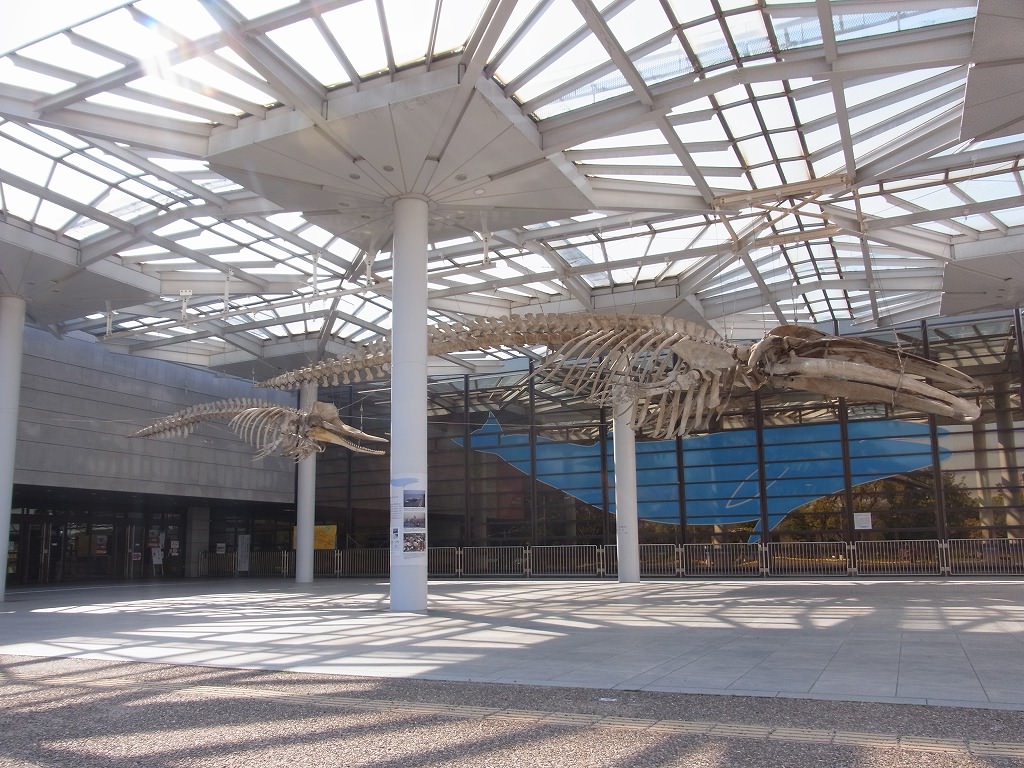
Finback whale "Nagasuke"
This sample is made from a carcass that was washed ashore on April 8, 1990, and it took us 7 years to turn it into a skeletal preparations. Although finback whales live in ocean all over the world, there have only been a few cases where their carcasses were washed ashore since they mostly swim off coast. The town of Osaka is covered with man-made artifacts. However, it seems like this finback whale is telling us that the sea of Osaka is also connected to the great nature where whales swim. This skeleton is 19 meters long, and is the largest specimen in whales that have been collected and exhibited in the waters near Japan.
The name "Nagasuke" was chosen from various names suggested by the museum visitors.
“Makko,” the sperm whale that drifted onto Osaka Bay
Since March 6th, 2014, the skeletal specimen of “Makko,” a sperm whale, has been displayed in this Porch next to the skeletal specimen of “Nagasuke,” the finback whale.
On May 22nd, 2010, the carcass of a sperm whale was found floating near the Sakaisenboku Port. It was a 9.1 meter long, approximately 10 ton female. It had 22 teeth on the left side of its lower jaw, and 24 on the right side. It had teeth on its upper jaw, but most of them were buried in its flesh and could not be seen at the time of dissection (Diagram 1). The long, thin notch on the very front of its upper body on its leftmost side is its nostril (Diagram 2). A defining characteristic of sperm whales is their asymmetrical heads.
The Osaka Museum of Natural History dissected this sperm whale and brought it back to our facility. Then, we buried it in sand and created skeletal specimen. The full skeletal specimen was unveiled to the public in 2013 for the special “Osaka Bay – A Cornucopia of Marine Life” exhibition, and as a result of asking citizens of Osaka to submit a name for it, it became known as “Makko.”